
Last updated on January 13th, 2026 at 12:44 am

Does your dog treat your backyard fence like it’s the first obstacle in an agility course? You’re not alone. Fence jumping is one of the most common (and most frustrating!) dog-parent problems, and it can quickly turn into an expensive and dangerous escape mission.
The good news? You don’t need fancy equipment or a brand-new fence to stop a dog from jumping. With a few smart, affordable changes and some dog-friendly behavior tweaks, you can reinforce your yard, keep your dog safely at home, and restore your peace of mind.
In this guide, you’ll learn why dogs jump fences, the easiest low-cost fixes that actually work, and how to pick the right solution for your dog’s breed, energy level, and motivation. Whether your dog is clearing a 4-foot chain link or scaling a block wall like a furry ninja, there’s a fix you can implement today.
Let’s keep your escape artist safely in the yard—without blowing your budget.
If you’re ready for a complete approach, from understanding why your dog jumps fences to training, equipment ideas, and behavior solutions, you’ll find it all in my book about easy for easy, step-by-step strategies, to save on your dog's expenses.
As an Amazon Associate, I earn from qualifying purchases. When you buy through links on our site, we may earn a commission at no cost to you. Learn more.
Budget tip:

Installing DIY coyote rollers which won't allow most dogs to jump over a fence can be a great and very affordable option. Most of the time you'll be able to come up with a simple solution, even a planting barrier, that doesn't cost much but will keep your dog safely within your yard. That's definitely a budget-wise tip for you and your dog.
What we love:
A trainer or behaviorist can help solve the issue
Coyote rollers to discourage jumping
Daily physical and mental exercise
Constant supervision to prevent a dog injury or a lost dog
Vibrate collar if you can't fence your yard
A well planned dog-friendly yard
Why Do Dogs Jump Fences?
Most dogs don’t jump fences randomly. Understanding what’s motivating the behavior is the first step toward stopping it safely and effectively. I always think it’s best to get to the cause of any issue, and that includes dog behavior issues. There could be a multitude of reasons why your dog might jump your fence. However, the most common reasons for your dog jumping a fence will be:
1. Boredom and Lack of Mental Stimulation
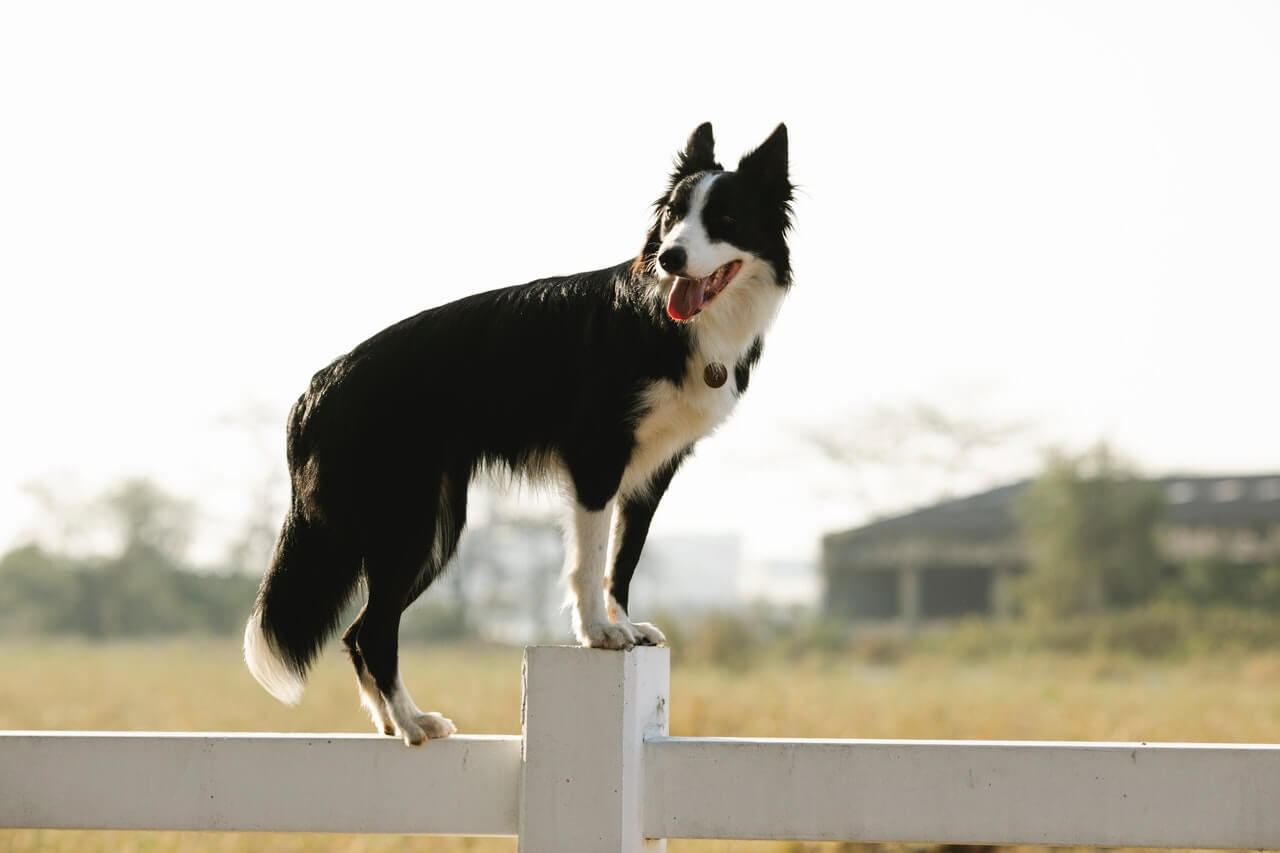
This would definitely be the reason Punky jumped the fence. She was a bored dog with a ton of energy. Punky always needed to be doing something. Border Collies are notorious for being high-energy dogs and needing a job. I don’t think my mom knew that when she brought Punky home with an infant already in the house.
2. Excess Energy and Not Enough Exercise
A dog who doesn’t get enough exercise can look for ways to burn off their energy. Including not enough mental stimulation.
Besides the typical toy play, you may want to think about:
3. Protecting or territorial
Your dog may be trying to protect you or his or her territory.
4. Prey Drive and Chasing Instincts
If your dog is highly motivated by prey and sees or smells something on the other side of the fence, your dog may be likely to attempt to jump.
5. Curiosity or Environmental Triggers
Some dogs, I swear, are part cat and are curious about what’s on the other side of the fence. They may walk on the other side multiple times a day, but they just want to check it out. I have a friend whose dog I call “catdog” because she is technically a dog, but acts more like a cat. I’m not sure how this happens. Although it seems to be more prevalent in smaller dogs.
A simple plan for your dog’s yard can often help. It will help you address containment issues and all your dog’s yard needs.
6. Mating
If you haven’t spayed or neutered your dog, then fence jumping might be due to wanting to find a mate. A simple and easy correction for this behavior will be to spay or neuter your dog. You can find a low-cost spay-neuter clinic near you by searching the PetSmart Charities online.
7. Breed Tendencies and High-Jumpers
Yep, unfortunately, certain dog breeds are more prone to jumping fences than others. If you have a German Shepherd, Golden Retriever, or, like Punky, a Border Collie, you have a natural-born fence jumper.
You’ll also need to know your dog’s abilities and limitations. For example, large dogs (like Great Danes) and older dogs may not create a huge jumping fence issue.
However, a newly adopted young Border Collie has a high risk of jumping over your fence. Although they are also wonderful at agility training. So, if you have a jumping dog breed, you’ll want to find your dog a job. That could include therapy dog training.
8. Separation Anxiety or Stress
If your dog only exhibits a need to jump when he or she’s left alone in your yard, then it could be due to separation anxiety. There are tricks to address and calm a dog with separation anxiety.
How to Stop a Dog From Jumping a Fence

You’ll want to observe your dog without your pup watching. Of course, you don’t want your dog to escape in the process. One way to do this is to put a harness on your dog and attach a long 15-30′ leash. You’ll want to have someone firmly hold the end of the leash, but allow your dog to roam as freely as possible. One trick is to act as if you’re ignoring your dog. But always have eyes, and if possible, a video camera on your dog.
At some point, your dog will most likely attempt to escape over the fence. Naturally, stop your dog before he or she jumps, but don’t injure your dog either. You may even want to have another person on the outside of the fence as additional help in case your dog jumps with the leash attached.
I know this part is a bit of a recon mission. However, the knowledge you’ll gain is very important. You’ll want to note how your dog tries to jump out, such as:
- Is there something that your dog jumps on and then tries to jump over your fence?
- Or does your dog simply attempt to jump from a standing position and hoist him or herself over your fence?
- Is there one spot your dog goes to jump your fence?
- Do you notice your dog sniffing before jumping over your fence? (This could be an indication of hunting.)
Simply put, you need to know how your dog jumps your fence, so you can correct it and prevent it from happening in the future.
Physical Solutions for Dog Fence Jumping

Once you know why and how your dog is jumping out of your fence, then you can get to work. There are a few tricks to solve your dog fence jumping issue. They will mostly be easy and inexpensive, my favorite kind of fixes.
You can look at the physical solutions to stop your dog from jumping your fence.
1. Start by removing the Jumping “Launch Points”
If your dog is jumping on something like a table and then onto your fence, simply move the table away from the fence a bit. By doing this, you will not enable your dog to jump over the fence so easily.
However, you may find your dog discovers another area to jump your fence. You’ll need to watch your dog again after removing the enabling item(s) to make sure your dog doesn’t find a new way over your fence.
2. Make your backyard more dog-friendly
Perhaps you created your yard and forgot about your dog. If so, you can add a dog digging zone, dog toys, agility games, a motion water drinking fountain, and even a dog path. These items will all help to encourage your dog to stay in your yard.
Not sure how to create a digging zone? In this article, I reveal how to do it.
3. Block the View to Reduce Excitement or Reactions
Some dogs simply react to everyone and passby their yard. When you block that with plantings or other options, it can keep your dog in your yard.
4. Fix Loose or Damaged Fence Panels First
A loose or damaged fence can easily give way to a dog trying to escape. It’s always a good to inspect your fence regularly. Especially after a storm and winter snow.
5. Create a Safe Barrier to Reduce Jump Height Like Plant Barriers
Your dog might be getting within 1-3 feet of your fence in one area and then jumping. If this is the case, then you can plant dog-friendly but thick plants that won’t allow your dog to jump from that location.
Of course, this may move your dog’s jumping to a different location. If this becomes the case, you may need to line the inside of your fence with thick bushes, such as:
- Bamboo
- Rhododendron
- Boxwood
- Juniper
6. Use Temporary or Portable Fencing Options
Sometimes all you need is a temporary solution while you teach your dog boundaries or give your plants a chance to grow.
7. Install a dog peek-a-boo window in your fence
This can work wonders for dogs jumping over fences due to curiosity about what’s on the other side of the fence. Of course, cutting a peek-a-boo dog window works best in a wooden fence. Yep, you can do this as an easy DIY project as well. Below is a simple video tutorial.
However, it can also increase the amount of barking you hear from your dog because your dog will see more people and animals, which could encourage barking.
8. Create an enclosed dog run
This will allow your dog to run in a certain area of your backyard, but keep your pup safe and prevent any fence jumping. Additionally, by only enclosing a small dog run, the costs are not as much as the entire backyard.
9. Add a Lean-In or Angled Fence Topper
Yes, this one does take a bit of skill. However, it’s not terribly difficult. Although if you aren’t comfortable with tools, you can hire a handyman, or hopefully you know someone handy who can do this one for you. And yes, you can make an existing chain link fence taller.
But first, when thinking about creating a taller fence line, there are three viable options:
Option 1. Awning effect
Basically, the idea with this option is to create a type of awning effect on the top of your existing fence facing in toward your yard at a 45-degree angle. The tools you need are fairly simple.
Below is a basic DIY on how to install a chicken wire fence awning over the top of your existing fence. But don’t worry, you can make that look pretty with some dog-friendly climbing vines, such as:
- Crossvine
- Purple passionflower
- Mustang grape
Option 2. Cat fencing
This option doesn’t allow for either a dog or a cat to jump over your yard fence. A cat fence is a plastic net that hangs much like an awning over your existing fence and prevents jumping.
Some pet owners have even trained dog-friendly vines to grow over the cat extension fence to add more decorative appeal to their backyard. You can ask at your local nursery for climbing vines that grow in your area. Then check to make sure they are pet-friendly by to the ASPCA plant site here.
Option 3. Privacy fence
And the final option to create a higher fence line is with a privacy fence. Confused? The privacy fence goes over the top of your existing fence. For example, a tall bamboo privacy fence over the top of your existing fence in one area may keep your dog from jumping. While also adding to your yard appeal.
Of course, the option you choose will depend on your dog’s jumping habits, dog breed, and abilities.
10. Consider Coyote Rollers or Roller Bars
The installation of coyote rollers can quickly stop your dog from trying to jump your fence. Additionally, outside animals and even a neighbor’s dog will not be able to jump into your yard.
Basically, the idea is that you install one, or some dog owners find it more beneficial to install two coyote rollers on the top of your fence line. These rollers are relatively inexpensive and made from PVC pipe and wire.
Additionally, a coyote roller can be installed on chain link fences with the proper tools.
Moreover, a coyote roller extends the fence height while also ensuring that your dog and predators can’t use the top of the fence to grab onto and propel over the fence.
Note: Most dogs and coyotes use the top rail of a fence to grab and leverage the rest of their bodies over the fence. However, if your dog doesn’t jump in this manner, then a coyote roller will probably not work.
While there are commercial coyote rollers on the market you can purchase, you can also easily make your own with just a few supplies. Here’s a link to how to create and install your own coyote roller.
12. Install a Second Inner Barrier
This option can be a bit pricey depending on what products you select. However, if you only install a second fence in your problem jumping area, it might be within your budget. The idea with a secondary fence is that you install another fence 2-3′ in front of your existing one.
Additionally, this new fence can be shorter and more decorative than your current fence, which may be more cost-effective. I’ve seen these secondary fences even created with pallets, which would be really inexpensive.
Basically, how a second fence works is that when your dog goes to jump it, he or she won’t have the room needed to jump the next fence. Although if your dog jumps from a standing position, a secondary fence may not work. You’ll discover this while watching your dog jump in your discovery period. Here’s a video on how to create your own secondary pallet wooden fence.
A word on both electric fences as well as invisible fences
You might be wondering about installing an electric fence or even an invisible fence to keep your dog in your yard. Both types of these fences will provide a shock to your dog if a certain line is crossed. An invisible fence requires your dog to wear a shock collar, which provides an electric shock to your dog.
Meanwhile, an electric fence provides a shock to anyone or anything that touches it.
What You Really Need to Know About Invisible Fences

Many years ago, when I was maybe seven, an old farmer said to me, “Always take care of your animals before you take care of yourself. If you wouldn’t drink the water, don’t give it to your animal.” He went on to say, “If their bowl is dirty, clean it. When they need something, do it. If you wouldn’t like it, then don’t do it to them.”
Those are certainly simple words and words I was mostly adhering to before he said them. Well, except I used to eat before my animals. But that quickly changed after his talk.
Anyhow, with regard to an electric fence and an invisible fence, I wouldn’t want to be shocked by either one. So, there’s no way I would let any animal I have be near one. I’ve been shocked a few times when changing electrical appliances, and it was no fun! If you’re thinking about an electric fence, I’d encourage you first to touch one and then think about it again.
Remember that anyone or anything that touches that fence when it’s on will be shocked. And then that naturally leads to a liability issue if the fence doesn’t have the proper signage denoting that it’s electrified, you could be liable if someone or something is injured.
Thus, an electric fence or even an invisible fence could be a cheap solution, but I would never support the use of either one.
Behavior and Training Solutions That Help
Thankfully, often all your dog will need is simple boundary training or other non-physical solutions.
1. Exercise your dog
If you discover your dog is jumping your fence out of boredom, try exercising your dog more. This might mean more or longer visits to the dog park. Or you may need to call in a dog walker or even take your dog to a doggie daycare if you find you don’t have enough time in your day to exercise your dog thoroughly.
Other great exercise ideas and bonding opportunities include:
2. Mental stimulation
Give your dog more mental stimulation, which can include a dog mental game. This can be very effective as long as your dog likes toys.
In addition to fence fixes, making sure your dog gets plenty of physical and mental activity really helps check out our great exercises with dogs for outdoor & indoor ideas.
3. Train your dog not to jump

Ok, I hear what you’re saying, “yeah right, and I’ll teach him to drive me to work too.” Well, if you can find the source or reason for jumping, and fix that issue, then in theory, you should be able to train your pup not jump over the physical fence.
Thus, it will be the same method as you use for sitting or staying. Just as you train your dog positively to sit, you’ll train your dog positively to stay away from the fence line.
Remember positive reinforcement with lots of treats when your dog responds as you desire. If you have an incredibly determined dog and he or she is still escaping your yard, then I encourage you to talk with your dog trainer for additional dog training assistance. Or consult an animal behaviorist for more guidance.
4. Don’t leave your dog unattended in your yard
After all these steps, you may discover, much like my mom did with Punky, that your dog simply needs supervision. That’s okay if that’s the case. Do what you can with exercise and mental stimulation, but always recognize your dog’s limitations.
For example, your dog may simply always be looking for something bigger and more exciting to do, regardless of what you put in front of him or her. These are the high-energy, job-driven dogs, like Border Collies.
However, that doesn’t mean that a Border Collie can’t make a wonderful family dog. I have two different friends who each have rescued two Border Collies. Both sets of these dog parents have learned that their dogs need jobs, but they also need supervision. One set of Border Collies goes to work with their human mom. While the other set of Border Collies keeps two acres clear of all critters.
Perhaps in these cases, it also helped for them to have two dogs. Interestingly, neither has had any issues with their Border Collies jumping over fences.
Training and behavior solutions are essential, and you can explore all of them, including printable sheets and step-by-step guidance, in my book that walks you through how to increase tail wags and decrease money spent.
Cheap Dog Fence Jumping Solutions
Honestly, the cheapest ways to keep your dog from jumping your fence will be:
- Exercise
- Mental stimulation
- Dog-friendly backyard
- Removing things that enable jumping
- Train your dog not to jump
- Don’t leave your dog unattended, so you don’t have a lost dog
However, as I stated above, my favorite, bar none, is a vibrate collar. It’s helped me train my dog, Henry, as to where the property lines are and what’s good and bad behavior. Although, I still never leave him unattended or encourage bad behavior that would lead to an escape.
You can get a great vibrating collar here! This is the one I will buy next.
1. Affordable Barriers That Work
These again can include plantings, a secondary fence, or training.
2. Low-Cost Yard Modifications
A low-cost yard modification would be to plant a thick shrub in front of your yard. You can generally get plants on sale at the end of the season, which can be perfect. Even a dog run can be a great alternative.
3. Budget-Friendly Training Tools
I always recommend looking at great YouTube training channels for assistance with teaching boundaries. I actually used a vibrate collar to help reinforce boundaries for Henry. It was a game-changer.
When to Bring in a Professional
There can be times when you will need help with your dog’s fence-jumping issues. Be mindful and realize when you need assistance. Don’t think of another expense. Think of it as keeping your dog safe and reducing future bills from injury or worse.
1. Signs Your Dog Needs a Trainer or Behaviorist
If you have made modifications and done all the other fixes for your yard as well as training, you may need additional help. It might be time to call a professional and get to the bottom of the issue.
2. The Type of Expert That Helps With Escape Behavior
Often, an animal behaviorist will be the one you will want to call if your dog is still escaping. They can get to the root cause and suggest ideas that will actually work for your pup.
3. What a Behaviorist Will Look for in Your Yard
A behaviorist will most likely inspect your yard and then observe your dog in your yard. If anything is setting your dog like wind, a neighbor dog barking, a particular area, or other noise, they will identify it and modify the issue.
FAQs
How to keep a dog from jumping a fence?
This could be a dog jumping outside your fence into your yard. Has this happened to you? If this is your worry, then try a deterrent such as coyote rollers.
How to stop a dog from jumping a 6ft fence?
Again, you’ll want to make sure you’re not enabling your dog with easy access or ways to jump over your fence. Then you’ll want to look at deterrents such as a coyote roller or even a cat awning.
How to stop a husky from jumping the fence?
Huskies are known as escape artists. Thus, you’ll want to make sure your yard is as secure as possible. Additionally, you won’t want to leave a husky alone in your yard, simply because they are so smart and will find ways to escape.
However, always make sure you don’t have items that encourage jumping such as tables by fences. Finally, training and deterrent tools like coyote rollers and cat awnings have been proven very successful, even for huskies.
How to keep a dog from jumping 4 foot fence?
The methods you use to keep your dog contained within a 4-foot fenced yard will be the same as a 6-foot fence. However, whether you choose to install a 4-foot or 6-foot fence will be determined by your dog’s ability and breed. For instance, a small Yorkie doesn’t need a 6-foot tall fence and 4 foot one will be perfect.
However, a Husky will need at least a 6-foot-tall fence. Either way, you’ll want to consider items keeping the fence clear of items that can encourage jumping like benches. Additionally, if your dog in a 4-foot fence needs more encouragement to stay in the yard, you’ll want to consider training, coyote rollers, and even a cat awning.
How to keep a dog from jumping a chain link fence?
Admittedly, a chain link fence is a bit more difficult to deter dogs from jumping. A lot of dogs can climb chain link fences, especially if they see something on the other side they want to investigate.
Thus, the first step is to break the sight line. This will mean installing a sight barrier fence. It could even be a temporary type of fence. The idea is not allow your dog to see outside your yard.
Next, you want to make sure your dog can’t get to the fence to scale it and leap out. This could mean installing bushes that will prevent your dog from getting close to the fence.
Finally, as an added measure, you’ll want to look at installing a deterrent to climbing, such as coyote rollers or a cat awning. Taken as a totality, these should keep your dog inside your chain-linked fence yard.
How high can a border collie jump?
Border collies are very athletic. I know my mom swore Punky could easily jump a 12-foot fence. I’ve seen some border leap and, honestly, I think Mom was probably right. Those dogs have springs in their legs.
How effective is an invisible fence?
Admittedly invisible fence can be very effective. However, it doesn’t prevent intruders. Additionally, if your dog is chased out of your yard, he/she won’t be able to come back because of the shock of the fence line. Personally, I think the cons of invisible fencing outweigh the pros. For me, I use a vibrating collar for my dog, Henry, and he’s been well trained. It works very well for us.
Here's where you can get a vibrating collar that is even better than Henry's collar. When his current collar needs to be replaced, I'll buy this one. Plus, it's very affordable!
How tall should a fence be for a medium-sized dog?
Keep in mind that the size of the dog may not matter so much if you have items next to your fence that encourage your dog to jump, such as a table or bench. This could be enticing for a large, medium, or small dog.
Also, if your dog can easily see out of your fence and there are things on the other side, like bunnies or other dogs, then that could encourage any dog to jump.
The type of fence may encourage your dog to jump. For example, a chain link fence will entice those dogs who like to climb. I was shocked to see Henry climb his playpen one day. He’s a rather small dog, and the height of the pen is about 3.5′. Thus, while the size may not matter, you know your dog and his/her skills do matter. Additionally, keeping your yard safe is always critical.
How to keep a dog from jumping a block wall?
Punky used to jump my mom’s block wall from a standing position. Honestly, the key to these super leapers is to not leave them unattended and to install secondary fences so they can never really get that close to the wall.
How to stop a dog from squeezing through a fence?
If your dog is squeezing through a hole in your fence, then you need to mend your fence. Additionally, I would recommend installing a deterrent so that your dog can’t get close enough to the fence to wiggle through it. In this case, you may want to look at a dog run. However, never leave your dog unattended for any amount of time. These types of dogs are very clever!
Are there items I can buy to stop dogs from jumping a fence?
Yes! While I like DIY, I also like being ready to go, especially when you need something immediately. Or maybe you’re simply not as DIY willing or able, then a quick buy is a great option. Heck, I often buy something rather than purchase for ease or because it saves me time or energy. So, there is something to be said for those types of savings as well.
NOTE: You can purchase coyote rollers like this one, which is very highly rated.
Personally, I’ve been using a vibrating collar with Henry for years with great success.
Click here for a fabulous vibrating collar that I will buy when Henry's current collar needs to be replaced.
Can I Save Money by Preventing My Dog From Jumping The Fence?
Absolutely! Think about the following for a moment:
| Possible Issue | Estimated Cost |
| Injury/Emergency Vet | $200 – 8,000 |
| Damaged Fence or Yard | $33 – 54/linear foot |
| Lost dog | $25 – 1,000 |
| Keeping your dog safely in your yard | PRICELESS!!! |
Want step-by-step behavior strategies and yard safety fixes? Check out what you can learn with my book that has simple solutions for your dog and wallet.
Related posts:
- Great Exercises With Dogs
- Easy Hack To Remove Sap From Dog’s Fur
- Mind Games For Dogs Every Dog Loves!
- A Dog-Friendly Backyard On A Budget
- Easy Dog Yard Digging Solutions
- Is There Cheap Temporary Dog Fencing? Yes!
Easy dog fence jumping solutions and how to stop a dog from jumping the fence
It can be scary and frustrating when your dog jumps your fence. However, there are generally good solutions to every problem. The first step is to know why and how your dog is jumping the fence. Once you know these answers, you can select an appropriate remedy for keeping your dog in your yard.
While it may be as easy as providing your dog with more exercise or mental stimulation, it could also involve a bit of labor. Such as moving something that enables your dog to jump your fence, like a table, or even planting some thick bushes.
Therefore, if your dog is persistent in jumping, you may even want to install a DIY coyote roller, which not only keeps your dog and cat safely in your yard but also keeps other animals from jumping into your yard.
I know my mom probably wishes she knew all these tricks for Punky. Honestly, I think Mom got a kick out of having the most famous dog in the neighborhood.



These are clever solutions to help dogs not jump the fence. I would have never thought of a barrier of plants and shrubs. Not only a great idea but would make the yard beautiful. Keeping them stimulated is another idea I would not have thought of off the top of my head. Thanks for sharing these helpful solutions.
I’m glad I was able to provide some new ideas for you. Some work well for cats too, like the coyote rollers and cat fence.
Thanks for your continued support, Kamira!
This is such an important dog safety post! We have a couple of people whose dogs keep getting out of the yard – recently, one dog escaped the yard and ran across a busy road, narrowly escaping being hit by a car. It’s so dangerous when dogs escape the yard. We had a neighbor once whose dog was constantly getting out of their yard. They would leave him alone in the yard for hours and he would get out somehow. One day he escaped the yard, got hit by a car right in front of their house, and died at the Vet shortly afterwards. It was heartbreaking & horrifying for the entire street, not just the family.
Oh my, I’m so sorry to hear about your neighbors’ dog.
You’re right, Cathy! A dog that escapes and jumps the fence can be an extreme safety issue. I hope some of these tips will help your current neighbors with keeping their dogs from escaping the yard. You’re also right, finding a way to remedy a jumping fence dog can be critical. Thank you for sharing this story. Hopefully, it will help others.
Great solutions for a fence jumper, I am blessed I have never had that problem but it can be so dangerous as dogs can get hurt also. A must read for all those with jumpers
I’m glad to hear you’ve never had to deal with a dog who jumps fences. Yes, it can be a frustrating and stressful situation. I’m hoping these tips will help those dog parents dealing with these types of dogs.
These are great solutions to help prevent a dog from jumping the fence! Not only do I love your recommendations, but I’m also glad that you pointed out some of the flaws of an invisible fence. My mother-in-law’s neighbors have one for their beagles. The dogs run out to chase something and then are afraid to go back into the yard. It is not unusual for them to be waiting at the front door. I keep hoping they will get a regular fence!
Oh my! The poor beagle! There are a lot of flaws with invisible fences. I’m definitely not a fan. Another flaw, which I didn’t point out in this article, is that they don’t protect your dog from intruding animals. So, a dog or wild animal can easily come into your yard and harass your dog, or worse. And one more point on invisible fences is that if your dog should get chased passed that shocked point by an invading animal, he or she won’t be able to come home because when that invisible line is approached either coming or going the dog will be shocked. Often people only think about keeping their dogs in their yard, but forget that they aren’t thinking about what they’re easily allowing into their yard and could easily get their dog. Fences, if done properly, should protect your dog and keep out intruders.
Thanks for allowing me to expand on invisible fences. I hope your mother-in-law will change her fencing methods. Maybe suggest she try it out. 😉
Wow, that is a lot of great information on preventing dog fence jumping. I know that my brother-in-law has a problem every time they get a lot of snow in the winter, as it makes the fence “shorter.” He had to extend the height for that reason, even though it was perfectly fine otherwise.
Oh wow! I had forgotten about snow shortening fence lines. That’s a great observation. Thanks for bringing that to my attention. I’m glad your brother-in-law was able to extend his fence line and keep his dog in the yard, even when it snows.
The best thing is those rollers as a dog can’t get past them. We have something similr here in New Zealand that works for cats. Our garden is such a terrible shape I can’t install them though AGGHH!
This is an important post and dog overs need to read it. Dogs are amazingly athletic and even a small dog can jump high.
You’re absolutely correct Marjorie, even small dogs can jump amazingly high. I’ve been shocked at how clever Henry has been with jumping when I’ve put him in a 4′ portable playpen. Somehow he becomes a gymnast and is so pleased at the short amount of time it takes him to leap of that fence. It became a game with him even though he’s considered a small cockapoo. I keep my eyes on him even in a 6-foot-tall fenced yard. When you mix athletic ability and cleverness, it can become a challenge. But all these tips are great for stopping even the most clever of dogs.
Margorie, the coyote rollers are DIY. You should be able to costume fit to your yard and keep your cats inside your backyard parameters. Or maybe a cat fence would work better? Probably for you, the concern is to keep other wildlife out.
Thanks for the continued support!
Excellent info on a topic not often talked about with such great “how to fix it” suggestions. First, having Siberian Huskies, we had to install a 6′ privacy fence they could not climb or jump, and because they are also notorious diggers, we cemented railroad ties that were driven into ground with metal posts…then dropped large shale border all around it to help “Husky-proof” it. They had a wondeful large area where they could dig and run and have a blast, so they were never bored. But, they are great small prey hunters, from catching birds mid-air to opossums, squirrels, and neighborhood cats who learned how to speed across the top of our fence! Prior to having Huskies, which is going back two decades, I had a German Shepherd/Akita who suddenly became afraid of thunder in her older years. We were always home…and naturally, we zipped out for just an errand, and she got spooked and scaled our then 4′ fence and got her collar hung up on it. Thankfully, a neighbor who was also a vet tech at our vet’s called the police, who knocked down our fence and she saved her and rushed her over to the hospital by us. From that moment on, 1) we tore down that fence and put up a 6′ one, 2) dogs went collarless together out in the yard for play (all microchipped), and 3) never left a dog outside alone again. I am Pinning and sharing your terrific post!
OMG!!! I hadn’t thought about collars being an issue. You’re absolutely right. A dog collar could cause an issue. That’s an excellent point. Wow, what a story. I’m glad the neighbors were home and acted so quickly. I’m also glad that you took action after that incident to prevent it from happening again. I wish more dog parents and pet parents had your mentality. Thank you so much for bravely telling your story.
I must thank you for the efforts you have put in penning this website. I really hope to see the same high-grade blog posts from you in the future as well. In fact, your creative writing abilities has motivated me to get my own, personal site now 😉
Awe, thank you! I’m inspired by your kind words. I hope to live up to them.
Best of luck! Henry sends his tail wagging good wishes to you as well. 😊🐶
With the holiday season approaching, we’re planning a trip with our dog. What tips can you share for preparing a pet for a long car ride? What should we bring along, and how can we minimize stress for our dog?
Great question! As far as what to bring along for your holiday trip with your dog, you can download a free checklist here. As far as how to keep your pup calm while you travel, there are a few tricks, including exercising your dog well before taking off, securing your dog safely with a dog safety belt, and stopping frequently. However, for my dog, Henry, I also give him a calm mushroom treat and take his heartbeat toy, which are big game changers. You can read more about each here.
If you have more questions, don’t hesitate to ask or email me directly.