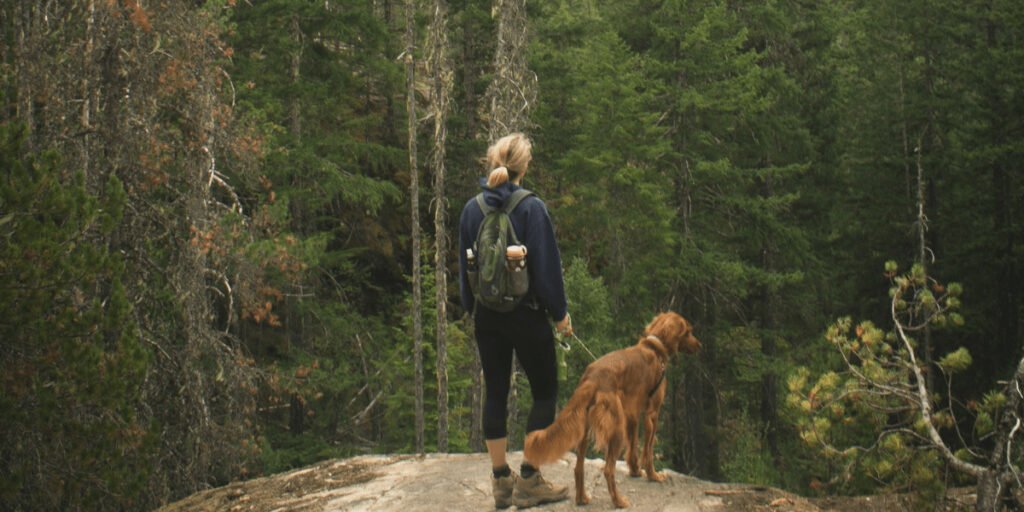

Dogs make amazing hiking companions, but if you struggle with back pain, hitting the trail can feel more stressful than relaxing.
The good news is that hiking with your dog doesn’t have to leave you sore for days afterward. A few simple adjustments, such as improving your posture, choosing the right gear, and preparing before your hike, can make a huge difference.
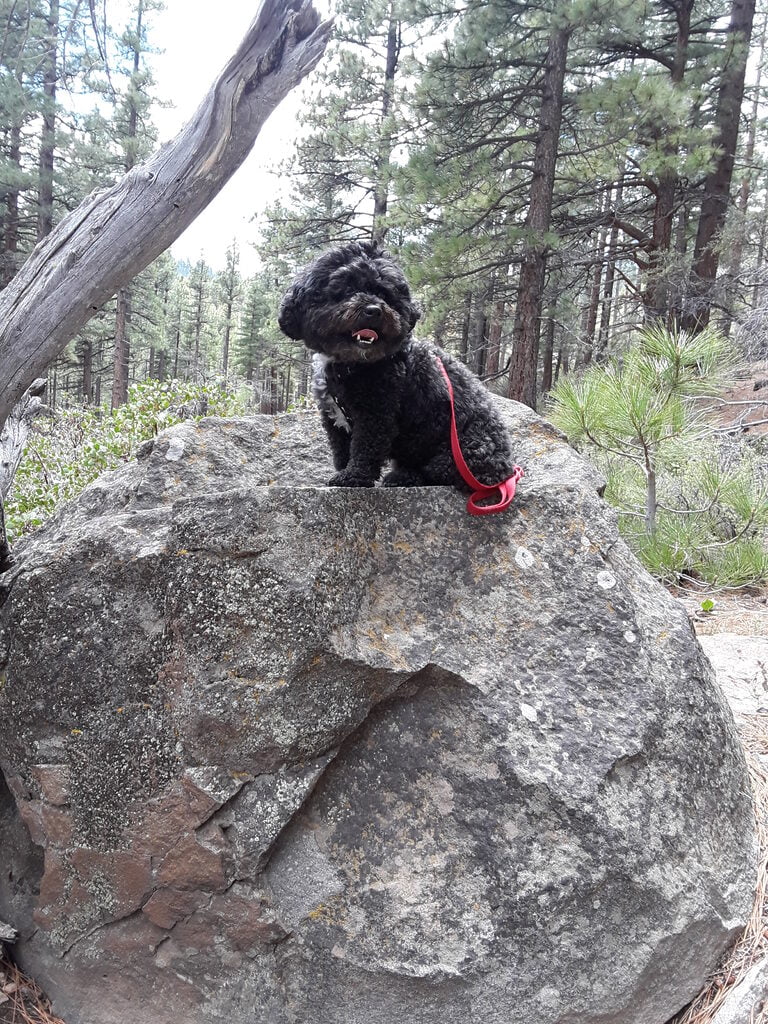
Even small dogs can be excellent hiking partners. My rescue Cockapoo Henry weighs about 13 pounds, and he loves exploring dog-friendly trails with me.
In this guide, you’ll learn how to enjoy dog hiking trails more comfortably, reduce strain on your back, and keep both you and your dog safe on the trail.
Note: Keep your doctor and veterinarian in the loop before starting any new hiking routine, especially if either you or your dog have existing health concerns.
As an Amazon Associate, I earn from qualifying purchases. I get commissions for purchases made through some links in this article. Learn more here.
Budget tip: Hiking with your dog and protecting your back isn't a budget buster. All the essential items you need for hiking are reusable and you can find sales if you look. It's like planting a tree you get to enjoy year after year. Henry and I both think it's good for the soul That's priceless!
Why Hiking With Your Dog Can Cause Back Pain
There are a few parts of hiking that can naturally increase back pain. They include:
- Pulling on leash
- Poor posture
- Carrying gear incorrectly
- Uneven terrain
- Weak core muscles
How to Prevent Back Pain While Hiking With Your Dog
Here are a few tricks I’ve learned that help my back prior to, during, and after hiking with my dog, Henry.
Stretching
Don’t fool yourself. Hiking is exercise. You want to loosen up your joints and muscles prior to hitting the trail. You may also want to stretch along the way.
Stretching will help reduce muscle fatigue and soreness. Additionally, it will improve your circulation and recovery time. Never stretch to the point of pain. Only stretch to where you feel a “good” stretch. Here are a few good stretches to do for your back prior to and after hiking.
Build Your Core Muscles
Your core muscles are basically the deep back and abdominal muscles. They attach the spine and pelvis to your torso or trunk of your body.
Your core muscles are responsible for supporting, moving, and protecting your spine. The stronger these muscles are, the less pain your spine will experience.
Here are some great core muscle exercises to help strengthen your spine.
Good Shoes or Hiking Boots
My grandmother used to always say that your feet are your foundation, and you have to take care of your foundation. She had a point. My mom used to always say that cheap shoes don’t help your body if they end up damaging your feet. She made a valid point as well.
When it comes to your back and hiking, you want to look for hiking boots that are:
- Comfortable
- Weatherproof
- Supportive
- Able to be worn for hours
They may not be cheap. But this is part of your foundation. You may find sales, especially around holidays or the end of the season, which can be great. In the past, I’ve found what I wanted and then waited for a sale. It was worth it.
Properly Fitting Backpack
Look for a backpack that fits comfortably and straps around your waist. You never want to overfill your backpack. However, you do want to be able to evenly distribute the contents, which should be fairly lightweight, across the back.
NOTE: For me using a backpack, even on a very short trail helps my back. It re-enforces my posture. Plus, at the bottom of the pack, I can put either one long or two shorter water bottles. For additional support, I will place the water bottles in the fridge for several hours. This lets my back experience almost a cooling massage as I hike. Honestly, this feels great!
Good Posture
Always remember your posture and try not to slouch. Yep, let your mom’s words come back to you loudly. Keep your core muscles engaged as much as possible, especially as you go up or down a mountainside. This will protect your spine from injury.
Trekking Poles
Many people find that using at least one trekking pole when hiking with their dog helps to reduce their back pain.
The idea of a trekking pole is to help to keep good posture throughout the hike. I haven’t tried this one yet, but the theory certainly makes sense. As the hike goes on, you can tire, and that’s when bad posture can sneak up on you.
Use a Hands-Free Dog Leash
You will often see runners using a hands-free leash. It can help with hiking as well by:
- Reducing twisting
- Reducing pulling stress
- Keeps your hands available for trekking poles
Listen To Your Body
As you are hiking with your dog, you’ll want to listen to your body.
If you need to stop and rest for 15 minutes, then do it.
You may be sore. But that’s better than pain.
Shorten your hike if you get overly tired, you are getting more sore, pain is increasing, or your dog is tiring or getting sore.
If you get dizzy or lightheaded. Stop immediately. Rest. Drink some water. If it doesn’t improve quickly, call for help.
I always recommend starting with really short trails early in the morning and then expanding as you and your dog get more experienced.
Additionally, don’t forget to drink lots of water and offer your dog water as well. You’ll want to pack nutritious items to eat like bananas, dried fruit, and trail mix. Remember, your dog may need some food as well.
Tip: Know your dog and your skill level. Don’t head out for a 12-mile hike if this is your or your dog’s first hike. Start small, maybe with a 1/4 mile hike, enjoy the scenery and work your way up.
Go at Your Own Pace
I know it’s easy to get out on a dog-friendly trail and then set some crazy goal. For instance, you see a mountain and think that’s where you need to head.
That may not be where you need to go on this hiking expedition.
Pace yourself and your dog appropriately so you can get off the trail before it’s dark.
Tip: Keep track of where you park and which way you went from your vehicle. I made this mistake once. It took me several extra hours to get back to my car. My dog, Henry was thrilled with the extra trail time. I was thoroughly exhausted and very grateful we didn’t meet any bears or mountain lions on the trek back.
My Favorite Dog Hiking Essentials
- Foldable Water Bowl – Your dog needs a way to drink safe water
- Dog Cooling Vest – Henry can do so much more with his cooling vest
- Pet First Aid Kit – It’s always good to be prepared and never need it
Post-Hike Back Care
When you get home, you will want to do a few things to reduce the chance of pain setting in your body. These include:
- Stretching
- Epsom salts bath (1.25 cups of Epsom salt in a bathtub with warm water)
- Continue drinking water
If you are in a lot of pain, I encourage you to seek medical attention.
Note: With physical therapy, I’ve learned exercises and how to compensate for back pain, including lower back. Physical therapy might benefit you as well. It could be something to discuss with your doctor.
Dog Hiking Essentials for a Safe and Comfortable Hike
Honestly, I should turn this part of the article over to Henry. He absolutely loves to hike, and I’m sure would be able to tell you what’s needed. But since he’s taking his mid-day nap, I’ll pinch-hit for him.
Plenty of Water
You and your dog need to drink lots of water while hiking.
Foldable Water Bowl
Your pup will need a way to drink water while hiking, and a foldable bowl is easy to hike with, clip on your backpack, or your belt loop.
This is a great travel bowl that comes in handy on hikes.
Poo Bags
I don’t know what it is, but as soon as we hit the trail, Henry has to poop. It’s the best remedy for constipation.
Remember, when you’re hiking, whatever you pack in, you need to pack out. That includes poop and poop bags. Your dog’s poo isn’t as biodegradable as a wild animal’s poo.
Besides, I always think that I’m in a wild animal’s home. So, I try to be a good guest.
I use these poop bags for Henry.
Dog Booties or Shoes
There are many dog booties on the market. Some are better than others.
It does take some effort to get your dog used to booties. If you’re planning to hike in a dog-friendly area that is rocky or weedy, it’s a great idea. They’ll keep each of your dog’s paw pads safe from injury.
Dog Backpack
There are backpacks made for even small dogs. They allow your dog to carry his or her food, treats (if you desire), poo bags, and a foldable bowl. I would never recommend putting much weight on your dog’s back. You certainly don’t want to give your dog a bad back. Also, make sure the weight is evenly distributed in the pack.
A Small Amount of Dog Food
If you are planning to hike a great distance, or if your dog only eats once a day, then you’ll want to pack a little dog food. Henry is generally too occupied with all the sniffs to think about food. Although he does drink while hiking.
Pet First Aid Kit
You could be surprised by what could happen at any given moment. Life is full of surprises.
Being prepared helps when you get thrown a curveball. That includes a pet first aid kit.
This is a great pre-made pet first aid – and it’s not expensive either!
Vet Check
Always check with your vet to make sure your pup is able to hike and that there are no underlying issues. Your vet may even recommend other vaccinations or preventative care if you plan to hike a lot with your dog like:
- Rattlesnake vaccine
- Flea and tick preventative treatment
- Leptospirosis vaccine (for the waterborne disease)
Dog Hiking Cooling Vest
I always have a cooling vest for Henry when we hike, unless it’s the fall or winter. It helps him stay cool, and he’s able to hike a lot longer.
Actually, he can hike miles more than I’m willing to even think about hiking with his cooling vest.
This is a great dog cooling vest, sure to keep your pup cooled just like Henry.
Small dog hiking tip: If you’re hiking with a small dog, I generally try to go first over large rocks or boulders. The first time I thought I might need to carry him over a boulder. Nope. He leaped as if it wasn’t even there. I thought my small dog somehow morphed into a large Great Dane. Basically, never underestimate your small dog’s abilities.
Should Dogs Wear a Harness While Hiking?
This will be up to you and your dog, as well as the trail rules. Personally, I like to keep a harness on Henry. I like this dog harness one because it has a front loop in case Henry’s on a pulling sniff and a back handle for a quick pick up.
Another dog owner on the hiking trail may let their dogs off-leash regardless of the park policy or their dog’s temperament. While Henry is extremely friendly, I don’t know if the other dog, wild animal, or even person will be friendly.
By having a harness on Henry and his leash attached, I’m able to protect him more quickly.
Small Dog Hiking Safety Tips (and Big Dogs Too)
Check-in
Let someone know where you are going and when you plan to return. Even if you’re hiking in a group, this is a good practice. Remember to check in with this contact person when you return. You don’t want to be a face on the 6 o’clock news for no good reason.
Tip: Look for trail maps. They will show the length, expertise skill level, and time it takes to hike the trail. This will give you an idea if a trail is right for you and your dog. You can find many trail maps online. They will also be posted within parks.
Cell phone
Take your cell phone with you. Even if your phone dies while on the hike. Or you and your dog should become lost, it’s still useful. Generally, authorities can ping the last spot you were at before the battery of your phone died.
Selfies
Remember, don’t try to get the impossible selfie with your dog hanging over a cliff. Always think about safety first when taking a photo or using your phone.
Bear spray
Take bear spray on the trail. I will generally hike with bear or pepper spray in my hand and ready to use. You never know what will happen or when. I mostly hike alone with just Henry. So, I’m always extremely cautious.
Layers
Dress in layers. As you hike, it can get warmer or cooler as clouds roll in along the trail. It’s always best to be prepared.
Watch for Wildlife
Keep your eyes open for wildlife when hiking. Watch for:
- Snakes
- Coyotes
- Bears
- Off-leash dogs
Sunscreen
Don’t forget the sunscreen. Yep, even if you’re covered up to start the hike, as you peel off the layers, you need to make sure you’re protected from the sun’s rays. You may even want to put a small travel-size sunscreen in your backpack. Remember, it’s easier to burn as you go up in elevation.
Avoid Unknown Water Sources
Waterborne diseases are often found in mountain streams. One drink can make you and your dog sick.
Actually, Henry contracted Giardia on the day I adopted him. We stopped at his now favorite hiking spot. Other dogs were drinking from the mountain stream. So, I let him drink as well.
The next day, we were at the vet, and the bill was much pricier than expected.
Post-Hike Care For Your Dog
Your dog may be tired and hungry. After a hike, you will want to care for your dog with:
- Food
- Water
- Massage (Henry loves his post-hike massages)
- Check for sap, stickers, ticks, scratches, and soreness
How Hiking With Your Dog Can Save Money
While hiking isn’t a replacement for veterinary care, regular exercise can support your dog’s overall health and potentially reduce some costs associated with inactivity and boredom-related behaviors. Consider the following cost savings of hiking with your dog.
| Possible Issue | Estimated Cost |
| Helps maintain a healthy weight | $30-100/month |
| Supports joint health | $500-2,000/year |
| Mental stimulation possibly reduces cognitive decline | $30-1,500 |
| Fewer boredom behaviors and destructive habits | $5-10,000+ |
| Hiking with your dog without pain and making memories | PRICELESS!!! |
Recent posts related to this article:
- Hack Lets You Easily Open Dog Poo Bags
- Do Dog Cooling Vests Help Summer Dogs?
- Keeping A Dog Safe With Off-Leash Dogs
- Quick Simple Way to do Dog Massage Therapy at Home
- How to Remove Sap From Your Dog’s Fur (Even If It’s Dried and Stuck)
Frequently Asked Questions About Hiking With Your Dog Without Pain
Can small dogs go hiking?
Yes. Many small dogs enjoy hiking and can handle longer trails than people expect. Start with shorter hikes and gradually build endurance while paying attention to your dog’s energy level. My Henry is small and hikes like a big dog.
How far can a dog hike in one day?
It depends on age, breed, fitness level, weather conditions, and terrain. Healthy adult dogs often hike several miles comfortably, but every dog is different.
Is hiking good exercise for dogs?
Yes. Hiking provides physical exercise, mental enrichment, and opportunities to explore new environments. Henry is always exhausted when we get back from a hike.
What should I bring when hiking with my dog?
Bring water, a collapsible bowl, waste bags, a leash, identification tags, snacks, bear spray, a basic pet first aid kit, and make sure your phone is in your pocket or backpack.
Final Thoughts on Dog Hiking Without Back Pain
Hiking with your dog can be very relaxing and soothing. Connecting with nature is always one of my favorite things to do with Henry. But I always look for ways to do it that protect my back from further pain. I can do this by stretching, using the right footwear, listening to my body, and taking care of myself after we return home.
Hiking with your dog doesn’t have to mean dealing with back pain afterward. The right preparation, proper gear, good posture, and realistic trail choices can help make every adventure more enjoyable for both of you.
Needless to say, hiking is one of Henry’s favorite things to do. I’m very happy to report he still gets lots of trail hikes each year. Although he would probably say it’s not enough. He could be right.