
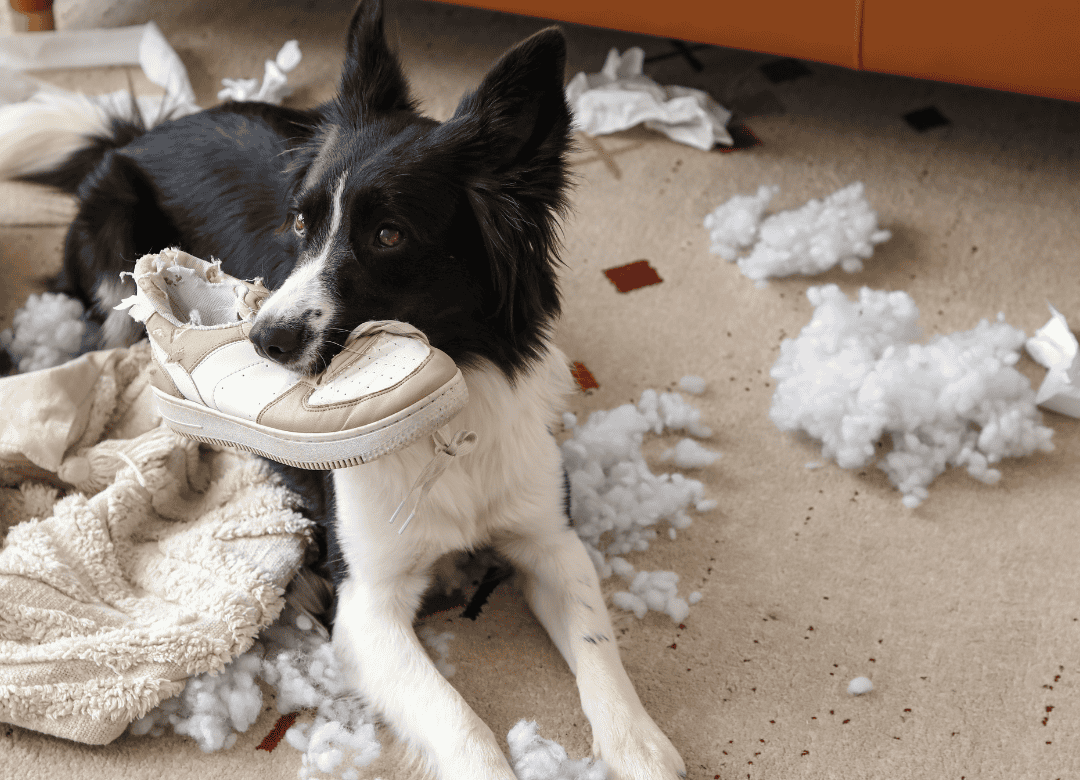

You may have discovered why your dog is destroying your home. Now, you need to know how to stop destructive dog behavior.
Half the battle is over by knowing the why. Now, you simply have to match the why to the best solution for your pup and you. Thankfully, most destructive behavior improves once you solve the right problem instead of guessing at random fixes.
Dog parents often think one solution will solve all the house destruction. That generally doesn’t work unless you know why the behavior is happening in the first place. Today, we’ll find the right solution for your pup.
📌 PIN FOR LATER!

As an Amazon Associate, I earn from qualifying purchases. I get commissions for purchases made through some links in this article. Learn more here.
Budget tip: Picking the best option for your dog’s destructive behavior from the start saves your furniture, house, and wallet from useless products.
Solutions for a Bored Dog
Remember each summer as a kid, you’d tell your Mom you were bored every day. The same holds true for your dog. No structure, routine, focus, or activity, and boredom occurs.
Solutions include:
- More enrichment games, like letting your dog sniff for hidden treats in the room
- Increase mental stimulation activities, like a slow sniff walk (my dog Henry loves this option)
- Frozen Kong toy
- Snuffle mat
- Frozen lick mat (Henry highly endorses this idea)
- Toy rotation (I like the idea of rotating toys every week when you do your deep cleaning)
- A dog walker can take your pup out more and let your dog enjoy a sniff walk
- Daycare can be a great cure for boredom (Henry always comes home happy and completely exhausted)
Every dog is different, so don’t worry if one idea works better than another. The goal is to find the combination that matches your dog’s needs.
Learn more:
- Discover how much mental enrichment your dog needs daily
- Learn how to make simple DIY toys
- Henry loves this lick mat
- This interactive lick toy entertains and lasts for 20 minutes
Solutions for a High-Energy Dog
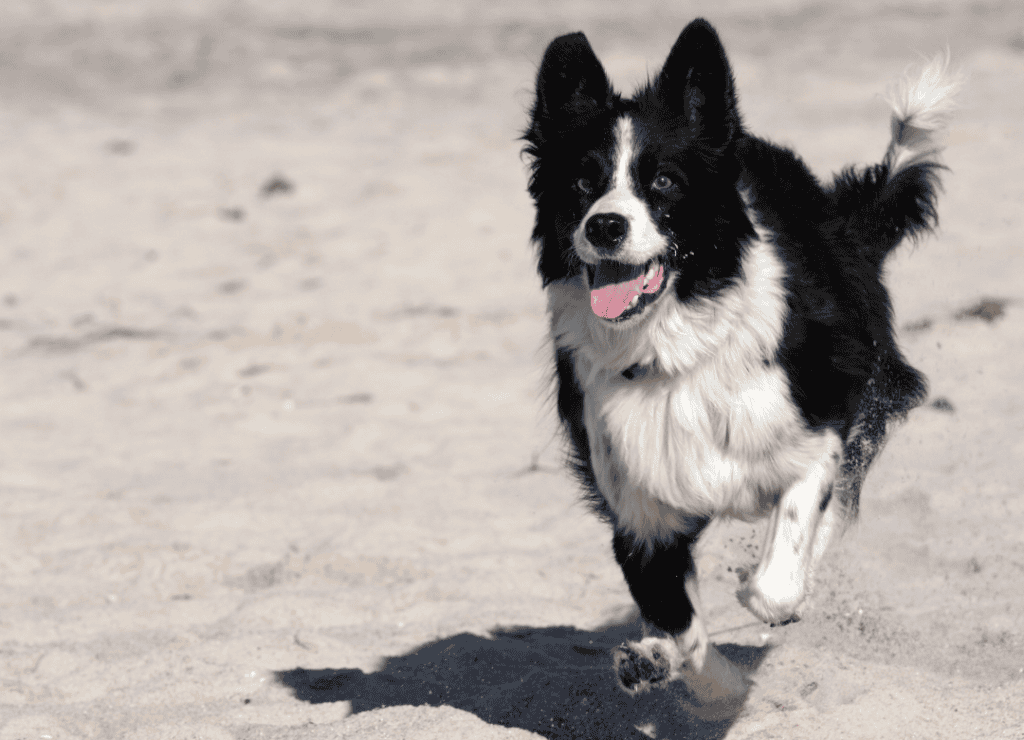
Some dog breeds, like Border Collies, Dalmatians, Siberian Huskies, Jack Russell Terriers, and Vizslas, naturally have a lot of energy. But you can help them manage that energy regardless of breed.
Solutions include:
- Automatic fetch toys
- More walks or higher intensity exercises like hiking or running (Henry loves hiking and always comes home exhausted)
- Dog walkers can help with increase activities
- Doggie daycare (I’m always amazed at how much Henry loves it and how tired he is when he comes home)
Finding the right option for your dog may take a bit of exploring, but it’s worth it. My family’s Border Collie would run circles in the backyard for 30 minutes every evening. It worked for her and my mom, who had a young family and health issues.
Learn more:
- This is a fun automatic fetching toy
- DIY ball launching toys can be a great idea
- Find a great dog walker
- Explore doggie daycare
Solutions for a Teething Puppy

Puppies explore and learn about their world as they grow into adult dogs. This may result in destructive dog behavior or destructive chewing of inappropriate items.
Solutions include:
- Using baby gates (or dog gates)
- Giving your pup an interactive toy or a frozen lick mat
- Supervising more
- Dog-proofing your home
- Giving your pup a safe spot to retreat so that nervous chewing doesn’t happen
- Start training with at least obedience
Remember that chewing is a normal part of puppy and young dog development. The goal isn’t to stop chewing altogether. Rather, it’s to redirect it toward appropriate items and away from chewing becoming a destructive habit.
Learn more:
Solutions for an Untrained Dog
Training teaches your dog what to do instead of simply telling them what not to do. Once your buddy understands expectations, destructive dog behavior often becomes much easier to manage.
Solutions include:
- Teaching basic obedience
- Using positive reinforcement training
- Giving your dog boundaries through training
- Using a dog trainer or YouTube for basic commands
I know it always feels overwhelming to train a dog. But when you break it down into small sessions, it’s easier for you and your pup.
Learn more:
- Train your dog on your time and budget
- Find a great dog trainer
- Teach your dog boundaries
- Consult a dog behaviorist
Solutions for an Anxious Dog

Henry’s destructive dog behavior wasn’t caused by boredom. It was anxiety. It took a while to find a combination of things that has basically solved his separation anxiety and loud noises anxiety.
Solutions include:
- Giving your pup a calm space to retreat
- Keeping to normal routines (walks, bed, meals, play)
- Gradually increase alone time from a minute, and slowly work up
- Calming music, TV shows, or movies can help (I always leave a Disney movie for Henry)
- Using a heartbeat toy can aid in a sense of calm (I’m shocked at how well it works for Henry)
- Giving your dog a calming supplement can be helpful
- Consult your vet for more help or prescription medicines
- Call an animal behaviorist to discover and resolve the root cause of the anxiety
Anxiety isn’t for humans or dogs. What works for one may not work for another. Or if your pup is like my Henry, then it’s finding the right combination of solutions.
Learn more:
- Heartbeat toys can work for separation anxiety
- Giving your dog a covered crate can be a great calm retreat
- Routines are important to dogs
- What finally solved Henry’s anxiety
Solutions for Dogs Struggling With Change
Moving can be stressful for you and your pup. Even getting settled into a new home is stressful. Or construction or even visitors can cause a change in behavior.
Solutions include:
- Giving your dog time to adjust to the new place, person, or pet with sniffing and exploring
- Sticking with a routine time for walks and meals
- Giving your dog a safe space with toys and blankets they love
- Frozen lick mats or chew toys
- Use a heartbeat toy for calm
Change is tough for humans and furry friends. Recognizing it’s a stressful time helps with solutions. You might be surprised that a walk with your pup helps your stress and your buddy as well.
Learn more:
- Create a safe space
- Routines are important
- Heartbeat toys are helpful
- Calm treats are yummy and work (Henry says these are his favorite)
Solutions When a Medical Problem Is the Cause
If you suspect a medical issue with your dog, always consult your vet. A lingering minor issue can quickly become a big, pricey problem.
Never assume your dog is “being bad” if the behavior suddenly appears out of nowhere.
If your dog is exhibiting any of these issues or suddenly has a change in what’s normal for them, then call your vet.
- Bumping into things
- Taking longer to get up or lie down
- Not hearing you when you walk behind them
- Moving slowly or with a limp
- Barking more, especially at night
- Pacing when it’s out of character (Henry roams the house at night. But he’s listening for coyotes. It took me a while to figure that out).
What If Your Dog Has More Than One Cause?
Life isn’t linear. That includes your dog. Actually, it’s pretty common for a dog to fit into more than one category.
Henry doesn’t do well with routine changes. It can trigger his anxiety. But I recognize it now. That lets me adjust early and help to manage it for him.
Solutions include:
- Recognizing your dog isn’t a perfect puzzle piece, and that’s fine
- Keeping to routines as much as possible [article]
- Giving your dog a spot that feels comforting with favorite toys [article]
- Increasing exercise or even sniff walks can be helpful [article]
- Engaging your dog’s brain with mental stimulation games or toys [article]
- Using calming aids like a heartbeat toy or calming supplement can help [affiliate link]
- Consulting your vet when you suspect a medical issue
If nothing else helps with the destructive behavior, then consult a dog behaviorist. They can find the root cause(s) and provide realistic solutions tailored to your dog.
The Best Solution For Dog Destructive Behavior Starts With Identifying the Cause
📌 PIN FOR LATER!

Once destructive behavior improves, most dog parents breathe a sigh of relief. But house destruction is only one way small problems become expensive.
Many dog parents are surprised to discover there are dozens of hidden expenses, from dental disease to escaping with fence jumping to separation anxiety, that quietly drain their budget.
That’s why prevention is so powerful.
Learn how to spot the hidden dog expenses that catch most dog parents off guard before they become expensive surprises.


Epic content, as usual. It can be quite tiring to have a dog that constantly destroys everything. Even small improvements make a world of difference to our sanity and that of the dog.
Thanks, Vanessa! I really appreciate your kind words. I completely agree that you don’t have to make drastic changes to have a big impact.
Another fantastic article, Terri! Having five high-energy dogs (Huskies) at one time – 3 of them littermate puppies (!!!) – destruction did happen! Deck rails, window ledges, book shelves, dog toys, and dog beds! Exercise was definitely key! I was fortunate that as they grew up, they had each other and we gave them an everyday side of the yard for them to have zoomies off the deck and back up and back off and back down…oh, oops…got a little sidetracked there! BOL! In addition to “their” side, we also opened up a gate to the larger side of the yard where they had some amazing crazy wild free zoomies! I can still see our silly Bandit…as they were running, she’d go so fast she would jump, lightly skim over the top of Gibson (I called it Husky surfing)…and keep right on going! I know I have videos! I have to look for them. I’d call them to the gate, and they would so polittely wait in line and run down the steps one at a time in a row! It really was so amazing, and fun, and sometimes I’d even join in the running. Snow was the best! At least if I fell, it was soft, then I’d have five noses over me checking to see if I was okay! Oh, fun times. But I digress in the memories…exercise really is the key to a happy Husky, or any dog!
Fetch was a favorite of Harley’s…she would play until the sun set! But tired Huskies (or any other high-energy dog) are happy dogs! After a good run, it was always so wonderful to watch them snuggle up for a nap! I love the auto Fetch you shared…they didn’t have one of those then, but I think about how many times I’d have to fling the tennis balls for Harley, and my arm would have appreciate that gizmo!
When my Wolfie was older and his anxiety increased, lick mats were a great thing. He never destroyed anything, thankfully, well…there were those stuffed squeaky toys…do they count?!
Great info as always! Sharing with my FiveSibes readers for sure!
Aww, thanks, Dorothy! I really appreciate it. I love you sharing your beautiful memories. I can picture Harley playing fetch, Bandit Husky surfing, and Wolfie enjoying his lick mats. So sweet! Great memories! I know they are still at your side. They never really leave.