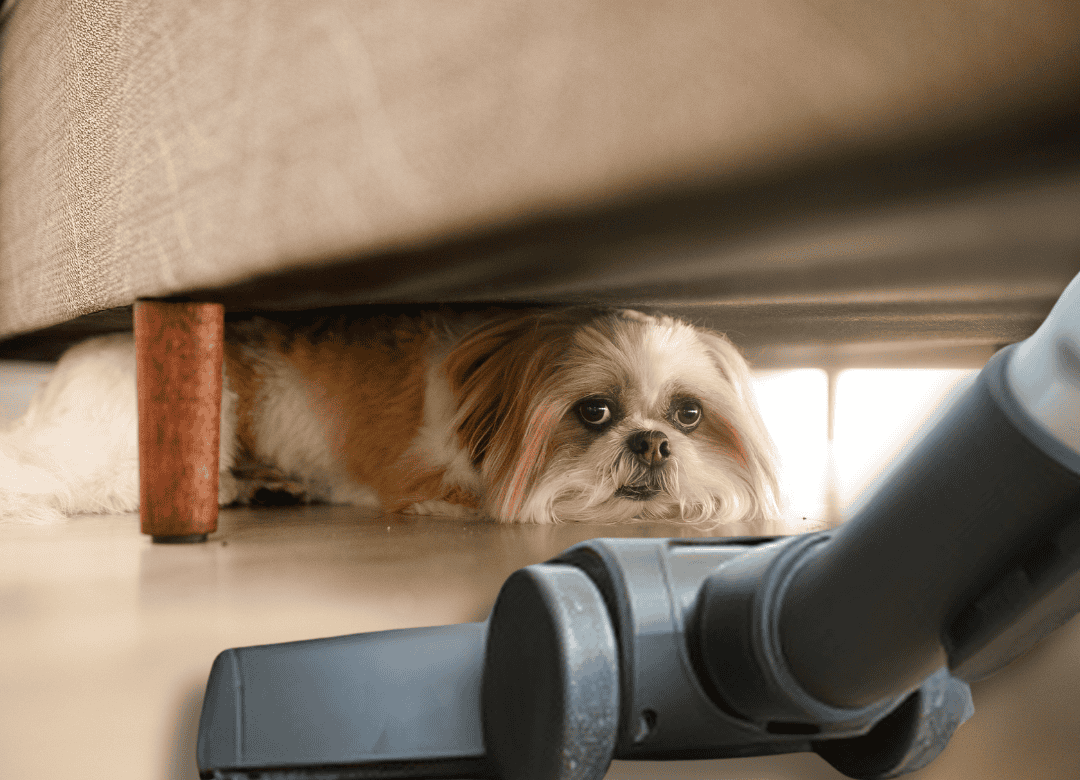

That vroom vroom from the vacuum is a good sign you’re getting your house clean. But to your dog, that loud, vibrating, headlighted beast that seems to chase them from room to room is wicked.
When the vacuum comes out, a lot of dogs hide. My dog, Henry, never got the memo that vacuums are scary. I admit he’s definitely not behaving like most pups. My other dogs hated the vacuum.
Seeing your dog bolt to their safe spot under the bed at the mere sight of the vacuum makes perfect sense. Even if your dog barks at or tries to bite the vacuum cleaner and seems to have lost all connection to reality, they are being rational. In short, your dog hides because the vacuum is loud, erratic, and headed straight at them.
The Vacuum Is Not Just Loud
Unfortunately, the sound of a vacuum cleaner doesn’t fully explain the fear. After all, a gas lawn mower runs around 90 decibels, while a household vacuum is closer to 70 decibels.
Plenty of dogs ignore the mower and lose their minds over the vacuum. Henry is in the camp of not minding the lawn mower.
The vacuum is different for your dog.
So what makes the vacuum different:
- It moves unpredictably, with no pattern a dog can learn
- It comes toward your dog instead of staying in one place
- It vibrates through the floor, so your dog feels it as well as hears it
- It runs in hallways and small rooms where escape is more difficult
- It whines at high frequencies your dog hears far more sharply than you do
- It has a light on the front that chases your pup
Meanwhile, the mower stays outside and keeps a steady line. The vacuum cleaner seems to follow your dog.
Hiding Is Your Dog Solving a Problem
A dog who hides is not being dramatic or disobedient. Your dog found the quietest enclosed spot in the house and went there to escape the loud beast.
That is good problem-solving. Under the bed, behind the couch, and in the bathroom are all smart moves.
Your dog is being smart by putting walls and distance between themselves and the vacuum.
Barking, Growling, and Biting Are the Same Fear
Of course, when you see a dog lunging at the vacuum cleaner, it looks aggressive. While a dog hiding looks scared. Really, both behaviors are responding to the situation from the same emotion. Fear.
- Hiding is flight. Your pup wants to leave the threat behind.
- Barking is distance-making. Your dog is trying to get the vacuum threat to back off.
- Growling is the warning that generally comes before barking.
- Biting or herding is the threat management tool some dogs use with the vacuum. This behavior is especially prevalent with herding breed dogs.
None of these are aggression toward you. Each one is your dog trying to get the cleaning beast to stop.
What Helps and What Makes It Worse
It helps your dog to:
- Set your dog up in another room behind a door before you start
- Give your pup a chew or stuffed toy a few minutes before you turn on the vacuum
- Leave the vacuum out and unplugged for a few days so your dog realizes it’s not that scary
- Vacuum one room at a time
- Take breaks instead of vacuuming all rooms at once
- Check on your dog during the breaks, especially if your pup is hiding
- Vacuum when your dog is being walked or playing in the yard
It makes your dog more fearful of the vacuum cleaner to:
- Pull your dog out of their hiding spot
- Bring the vacuum close to your pup, trying to prove there is nothing to fear
- Offer reassurance in a worried voice. It only reaffirms to your dog that they are correct to be fearful.
- Run the vacuum right past your pup’s crate or bed, especially when they are hiding in those spots.
When to Pay Closer Attention to Your Dog’s Vacuum Cleaner Fear
Watch what happens after you switch the vacuum off.
A dog who comes out in a few minutes and shakes off is fine.
But there may be more to the fear if your dog:
- Stays shut down for an hour or more
- Pants hard even when the vacuum is turned off
- Drools at the sight of the vacuum
- Tries to dig a hole to escape
Also, if you notice your dog’s vacuum fear has spread to other sounds, like a car alarm, or your pup is frantically trying to escape, talk to your vet or an animal behaviorist.
The Bottom Line on Dogs Who Hide From the Vacuum

Turning on your vacuum cleaner isn’t being mean to your dog.
The vacuum is simply scary, and your dog’s instinct to hide is smart.
The next time you see your dog darting for their favorite hiding spot when you’re cleaning, don’t get frustrated. Realize your pup is a great problem solver.
Or if your dog is like Henry and loves to help with all chores, realize that’s fine for them as well.
Fun Dog Fact: Dogs hear frequencies up to roughly 45,000 Hz. But people can only hear to about 23,000 Hz. That means the whirling sound of the vacuum is a completely different experience for your dog.
What’s Next:
- Dog Doorbell Barking: Why It Happens and How to Finally Stop It
- Creating Dog Safe Spaces: Easy and Cheap
- How to Calm a Dog: 12 Effective Solutions for Anxiety and Panic
- Hidden Dog Expenses: Why Good Dog Parents Spend More Than They Expect
Want more fun dog tips and insights? Then Henry and I invite you to join our weekly newsletter.